
In the Pacific Northwest, our highways are the lifelines of the economy, connecting the Willamette Valley to the Columbia River Gorge and linking the bustling hubs of Portland and Vancouver. For the crews working on these stretches of asphalt, the road is a high-stakes environment. As traffic volume increases and distracted driving remains a persistent threat, safety cannot be left to luck.
At Rose City Flagging, we know that the difference between a “near miss” and a tragedy often comes down to having the right steel in the right place. The Truck Mounted Attenuator (TMA) truck—often called a “Scorpion Truck”—is the ultimate invisible barrier between high-speed traffic and vulnerable human lives.
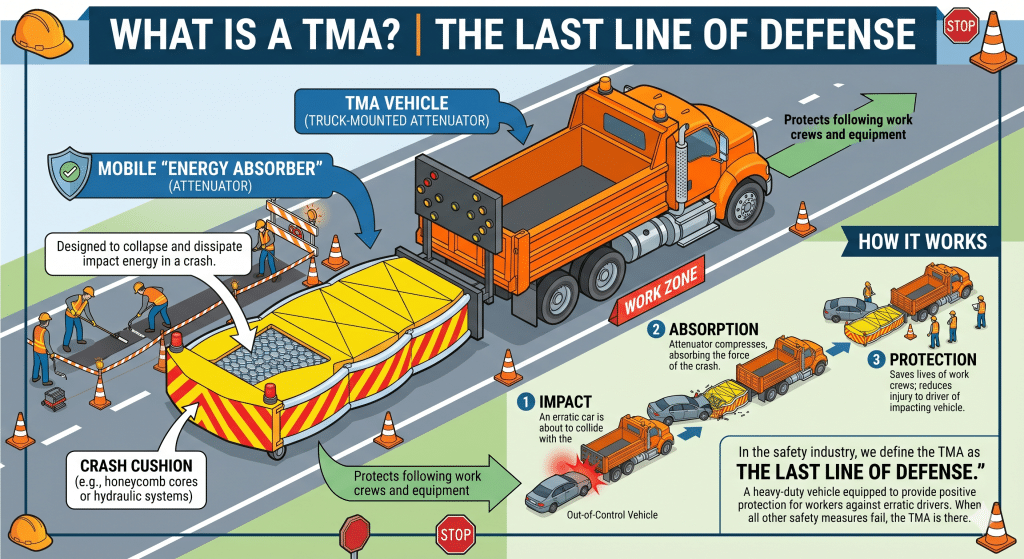
What is a TMA? The Last Line of Defense
A TMA is a heavy-duty vehicle equipped with a mobile “energy absorber” attached to the rear. In the safety industry, we define the TMA as the last line of defense.
While cones, signage, and expert flaggers provide the necessary warnings to direct traffic, they cannot physically stop a distracted or impaired driver from entering a work zone. When a vehicle veers off-course at 65 mph, the TMA truck stands as a sacrificial shield. It is positioned strategically behind the work crew, ensuring that if a collision occurs, the impact is absorbed by engineered aluminum and steel rather than by the men and women on the ground.
The Physics of Safety: Designed to be Destroyed
The true value of a TMA truck lies in the physics of kinetic energy. When a passenger vehicle strikes a stationary object, that energy must go somewhere. Without an attenuator, that energy is transferred directly into the striking vehicle and the object it hits—often with catastrophic results.
TMAs are engineered to collapse in a controlled manner. Using advanced “honeycomb” structures, the attenuator dissipates the kinetic energy of a crash:
- For the Motorist: The gradual compression of the attenuator slows the striking vehicle down over a short distance, significantly reducing the G-forces exerted on the passengers.
- For the Workers: The massive weight of the TMA truck, combined with specialized braking systems, ensures the vehicle remains a steadfast barrier, preventing the striking car from ever reaching the “buffer space” where crews are operating.
New Mandates: “Super Loads” and Oregon Requirements
The regulatory landscape in the PNW is shifting. A critical update for 2026 involves oversized loads—or “Super Loads.” Oregon is now requiring formal flagging and traffic control for these massive transports, a significant change from previous years.
Because these loads move slower than the flow of traffic and often occupy multiple lanes, a TMA truck is no longer just “recommended”; it is a vital shield for the mobile convoy. Whether you are moving heavy equipment through the Willamette Valley or navigating the tight corridors of the Columbia River Gorge, staying compliant with these new ODOT requirements is essential for your project’s permit and safety.
Liability and the “Nits and Gritties” of Compliance
In Oregon and Washington, road safety isn’t just a best practice—it’s a legal mandate. However, every jurisdiction has its own “nits and gritties.” For example, the Portland Bureau of Transportation (PBOT) has specific rules that differ from ODOT or WSDOT.
Failing to provide a MASH-compliant TMA when required can lead to:
- Work site shutdowns: Non-compliant sites are often red-flagged by inspectors.
- Insurance Risks: In the event of an accident, the first question asked is whether the site met state safety standards.
- Legal Exposure: Using a TMA demonstrates a “Standard of Care” that protects your company’s reputation and bottom line.
Why Renting from Rose City Flagging is the Smart Move
For contractors from Vancouver to Salem, the decision to rent equipment versus buy comes down to flexibility and expertise. Here is why the PNW’s top crews choose Rose City Flagging:
1. Latest MASH-Compliant Models
Safety standards evolve. The Manual for Assessing Safety Hardware (MASH) is the current gold standard for crash testing. When you rent from us, you get access to the latest MASH-compliant models, ensuring you aren’t stuck with outdated technology that doesn’t meet 2026 requirements.
2. Zero Maintenance & Storage
TMA trucks are complex machines. The attenuator units require regular inspections and the hydraulic systems must be in peak condition. We handle all the upkeep, oil changes, and specialized repairs. You get a work-ready vehicle delivered to your site, and we take it back when the job is done.
3. Local Expertise & 24/7 Availability
Roadwork doesn’t follow a 9-to-5 schedule. Whether it’s an emergency repair on I-5 or a scheduled night shift in the Portland metro area, we offer 24/7 availability. Our team, led by experts with an “encyclopedic” knowledge of traffic laws, ensures your setup is right the first time.
4. Scalability for Regional Projects
Whether your project is in the heart of Portland, the rural stretches of Idaho, or the highways of Washington, renting allows you to scale your fleet instantly without the massive capital expenditure of purchasing specialized vehicles.
Protect Your People, Not Just Your Project
The men and women behind the cones are people with bright futures—students studying psychology or IT, and veteran experts who keep our infrastructure moving. They deserve to go home at the end of every shift.
At Rose City Flagging, we provide more than just equipment; we provide the peace of mind that comes with knowing your site is protected by the best technology available.Keep your team safe, your site compliant, and your liability low. Request a Quote for TMA Rental TodayServing Portland, Vancouver, the Willamette Valley, and beyond.