
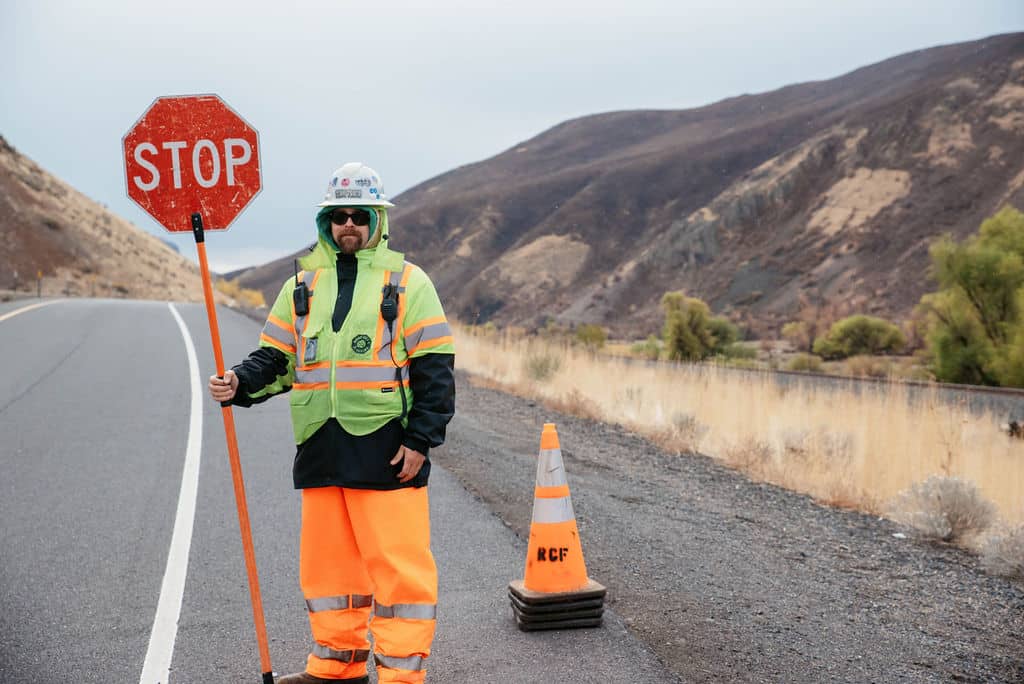
Washington State has been making headlines for aggressive work zone safety enforcement — and it’s no longer just about highway patrol cars. Contractors running projects on state highways face a rigorous, dual-regulated set of requirements from both WSDOT and Washington L&I. With new automated enforcement laws live, the stakes for compliance have never been higher.
If you’re mobilizing a crew for road work in Washington, this guide covers exactly what the state requires: traffic control plans, certified flaggers, worker protection standards, and the automated speed enforcement tools shifting driver behavior.
Who Governs Work Zone Safety in Washington?
Two distinct state agencies share authority over Washington work zones, and contractors must answer to both:
- The Washington State Department of Transportation (WSDOT): WSDOT sets the standards for temporary traffic control on state highways. They follow the federal Manual on Uniform Traffic Control Devices (MUTCD), Part 6, alongside the strict provisions of the WSDOT Design Manual. WSDOT governs how you manage traffic around your work zone.
- Washington Labor & Industries (L&I): L&I regulates worker safety within the boundaries of the job site under WAC 296-155, Part J (Construction Work Zone Safety). As the state’s version of OSHA, L&I governs how you protect the people working inside the zone.
Core Work Zone Safety Requirements for Washington Contractors
1. Mandatory Traffic Control Plans (TCP)
Any construction, maintenance, or utility work affecting traffic flow on a Washington state highway requires an approved Traffic Control Plan (TCP) before mobilization.
For routine or minor closures, WSDOT publishes standard plan templates. However, complex projects—such as multi-lane closures, night work, or Interstate projects—typically require a registered Professional Engineer (PE) to custom-design and stamp the TCP.
Your on-site TCP must always be available for review by inspectors and must explicitly details device placement, taper lengths, buffer zones, and accommodations for pedestrians or cyclists.
2. Certified Flaggers Only (Physical Cards Required)
Every flagger working on a public roadway in Washington must hold a valid Washington State Certified Flagger card (or a valid card from a reciprocal state like Oregon or Idaho). This requires an 8-hour WSDOT-approved training course and passing an examination.
Compliance Alert: Per WAC 296-155-305, flaggers must carry their physical certification card on the job site at all times. Digital copies or smartphone screenshots are routinely rejected by inspectors.
If a WSDOT project engineer or L&I inspector finds an uncertified flagger or someone without their physical card on-site, they have the authority to trigger an immediate work stoppage for that operation, costing you time and money.
3. High-Visibility Apparel Standards
Under WAC 296-155-200, high-visibility outer garments (vibrant orange, yellow-green, or red) are mandatory.
- Daylight Hours: Workers must wear highly visible outer garments when working near moving traffic.
- Hours of Darkness: Workers must wear a minimum of ANSI/ISEA 107 Class 2 apparel configured for 360-degree visibility.
Contractor Best Practice: Due to Washington’s frequent fog, heavy rain, and low-light conditions, implementing Class 3 apparel for flaggers and high-exposure personnel is highly recommended to mitigate liability.
4. Advance WSDOT Lane Closure Notifications
You cannot simply show up and drop cones. Lane and shoulder closures require advance coordination with the specific WSDOT Region office handling that territory. Depending on the region and the scale of the closure, notice must be given days or weeks in advance, occasionally requiring coordination with the Washington State Patrol (WSP).
Washington’s Automated Work Zone Speed Camera Program
A massive shift in state enforcement landed when Washington fully launched its Automated Work Zone Speed Camera Program. Trailer-mounted photo-radar cameras are deployed dynamically in active state highway work zones.
Camera Citation Fine Schedule:
- The Baseline: Cameras capture vehicles speeding when workers are present on the job site.
- Current Fines: Currently, the first photo enforcement infraction results in a $0 warning, while the second and subsequent infractions trigger a $248 fine.
- The July 1, 2026 Law Shift: The state legislature voted to eliminate the warning period. Beginning July 1, 2026, the very first speed camera infraction will carry a mandatory $125 fine.
For contractors, this automated system makes flawless work zone signage and proper taper layouts crucial. Clear, compliant signage is your first line of defense against high-speed vehicle intrusions.
Common Work Zone Compliance Failures
When WSDOT and L&I issue citations or halt projects, it is usually due to these preventable mistakes:
- Expired Flagger Cards: Washington certifications expire every three years. Crews who self-manage their flagging frequently miss these renewal dates.
- TCP Discrepancies: The traffic control setup deployed in the field does not match the signed drawing on file. If field conditions force a change, the TCP must be formally updated.
- Improper Device Spacing: Using lower-speed local street spacing layouts (taper lengths and cone gaps) on high-speed state highways.
- Missing Physical Credentials: Flaggers leaving their physical wallet cards in their personal vehicles or at home.
Protect Your Project with a Certified Traffic Control Team
Don’t let a compliance oversight or an uncertified crew shut down your job site. Rose City Flagging provides fully certified flagging crews and comprehensive traffic control support for contractors, utilities, and public agencies across Washington.
Our professional crews carry valid, current certifications and manage your setups strictly to WSDOT, L&I, and MUTCD standards. We handle the setups, the credentials, and the field compliance so your crew can focus safely on building.
Contact Rose City Flagging today to book a compliant crew for your next Washington project.